
Why is NAD+ Clear or Light Yellow? Formulation, Packaging, and Visual Inspection Explained
In this article
For clinic owners, researchers, and individual buyers, visual inspection is often the first step in verifying the quality of peptide and coenzyme products. Recently, a common question has surfaced in the peptide community: Why does NAD+ sometimes reconstitute clear, while other times it has a slight yellow tint? More confusingly, why can two vials from the exact same batch look different?
At Olvipep—a trusted institutional peptide supply providing high-purity raw APIs—we believe in absolute transparency. Whether you are stocking up for a medical spa, supplying a research lab, or distributing private label products, understanding the chemical nature of NAD+ (Nicotinamide Adenine Dinucleotide) is essential for accurate visual inspection and quality control.
The Core Question: Why is NAD+ Sometimes Yellow and Sometimes Clear?
NAD+ naturally exists as a white or off-white lyophilized powder. When reconstituted with bacteriostatic water, the resulting solution can range from crystal clear to a faint transparent yellow. This variance is generally driven by three critical parameters:
1. Oxidation and Degradation NAD+ is highly sensitive to light, heat, and moisture. A faint yellow tint is often the first visible sign of mild oxidation or structural degradation. While a very slight yellowing does not necessarily mean the product is completely degraded or ineffective, it indicates that the coenzyme has been exposed to environmental stressors.
2. Formulation and Buffering In clinical applications (such as NAD+ IV therapy), solutions are often buffered to adjust the pH, making injections more comfortable. Buffered NAD+ formulations may naturally exhibit a slight yellowish hue depending on the specific excipients and pH stabilizers used during the lyophilization (freeze-drying) process.
3. Why the Inconsistency Within the Same Batch? This is the most perplexing issue for buyers. If you receive three vials of NAD+ from the same lot, why might two be crystal clear and one be light yellow?
- Micro-Leaks and Vacuum Loss: Vials are vacuum-sealed after freeze-drying. If a single vial has a microscopic imperfection in the rubber stopper or the crimp, ambient air and moisture can slowly seep in, causing localized oxidation (yellowing) in that specific vial.
- Residual Moisture Variance: During large-scale lyophilization, vials at the edges of the freeze-dryer trays may retain a fraction of a percent more moisture than those in the center, accelerating mild degradation over time.
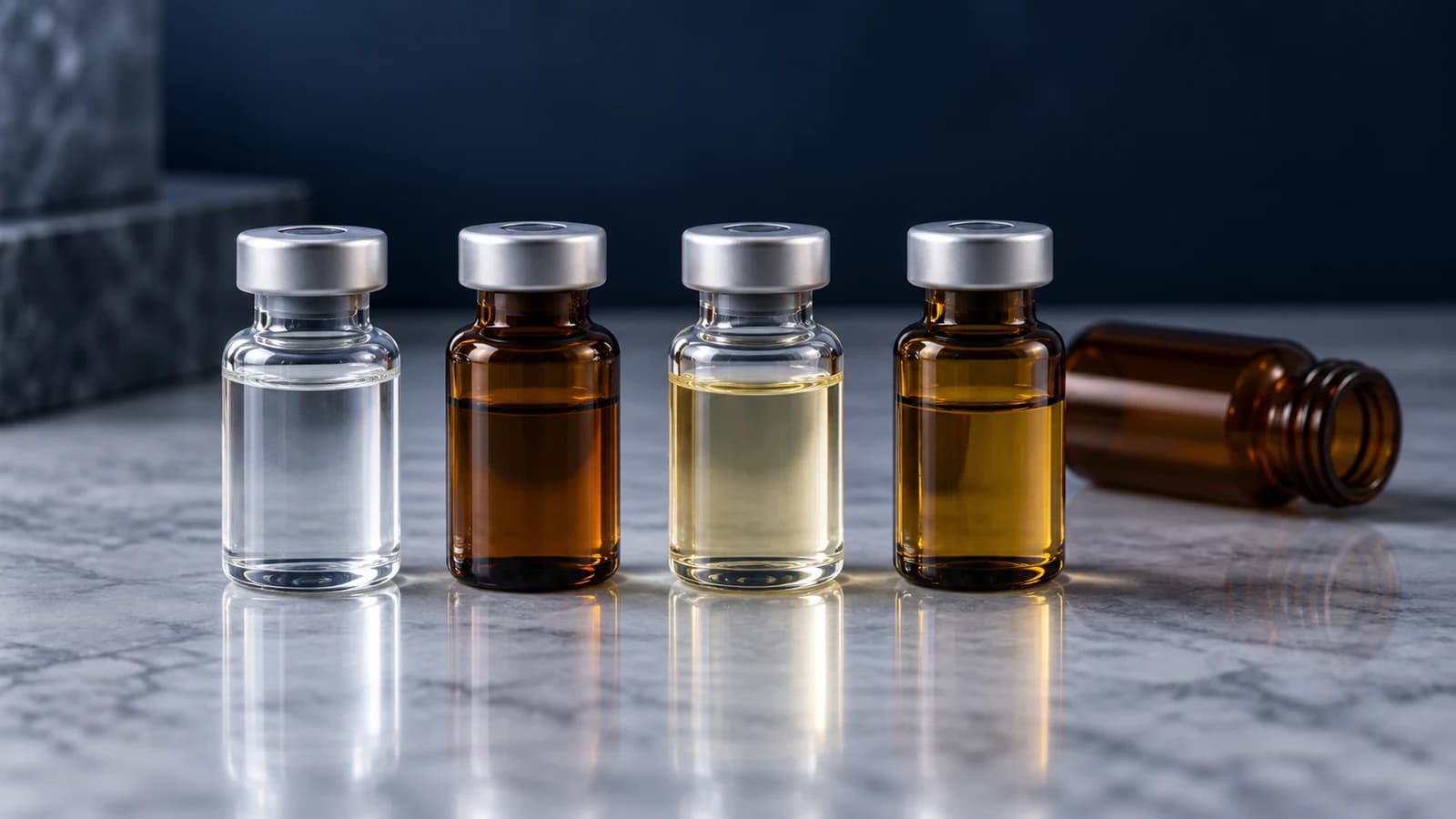
Packaging Matters: Amber Vials vs. Clear Vials
Because NAD+ is notoriously light-sensitive, packaging plays a crucial role in its stability.
- Amber Vials: Many premium NAD+ products are packaged in amber (brown) glass vials. The amber tint blocks UV light, significantly slowing down photodegradation. If you are examining an amber vial, it can be difficult to judge the color of the solution until it is drawn into a syringe.
- Clear Vials: Clear vials allow for immediate visual inspection but offer no UV protection. If your NAD+ comes in a clear vial, it must be stored in a dark, temperature-controlled environment strictly away from light.
Reconstitution Issues: The "Vacuum" Effect
Some users report that the lyophilized powder is an off-white yellowish color, and upon reconstitution, they find it "difficult to push the bacteriostatic water through" the syringe. This resistance is a pressure issue. High-quality lyophilized products are sealed under a vacuum. When piercing the stopper, the vacuum should naturally pull the bacteriostatic water into the vial. If it is hard to push the water in, it indicates a lack of vacuum or positive pressure buildup—often a sign of a compromised seal or improper lyophilization environment.
Visual Inspection Guide for Buyers
To ensure you are providing top-tier products to your clients or using reliable materials for research, follow this visual acceptance checklist for NAD+:
- Powder Appearance: Should be a solid, uniform white to slightly off-white lyophilized puck or powder. Dark yellow or brown powder indicates severe degradation.
- Reconstitution Color: Crystal clear is ideal. A very faint, transparent yellow is acceptable in buffered formulations or slightly aged stock, but deep yellow or cloudy solutions should be discarded.
- Solubility: The powder should dissolve rapidly and completely when mixed with bacteriostatic water.
- Seal Integrity: Ensure the flip-top cap and aluminum crimp are intact.
The Olvipep Quality Standard
As a premier supplier of Institutional Peptide Supply & High-Purity Raw APIs, Olvipep prioritizes rigorous Quality Control. We utilize advanced freeze-drying technologies and optimal packaging to ensure maximum stability for sensitive compounds like NAD+.
Every batch we synthesize is backed by third-party testing. You can easily verify COAs for all our products to guarantee purity and molecular integrity.
Whether you are looking to source high-purity NAD+, stock up on metabolic research peptides like Tirzepatide and Retatrutide, or source targeted compounds like HGH Fragment 176-191, Olvipep has the capacity to support your business.
Partner With Us Today
- Explore our full Product Catalog.
- Need larger quantities? Learn about our Wholesale & Private Label programs or Custom Peptide Synthesis.
- Ready to order? Request a Quote, reach out via our Contact Page, or chat with us instantly on SalesChat.